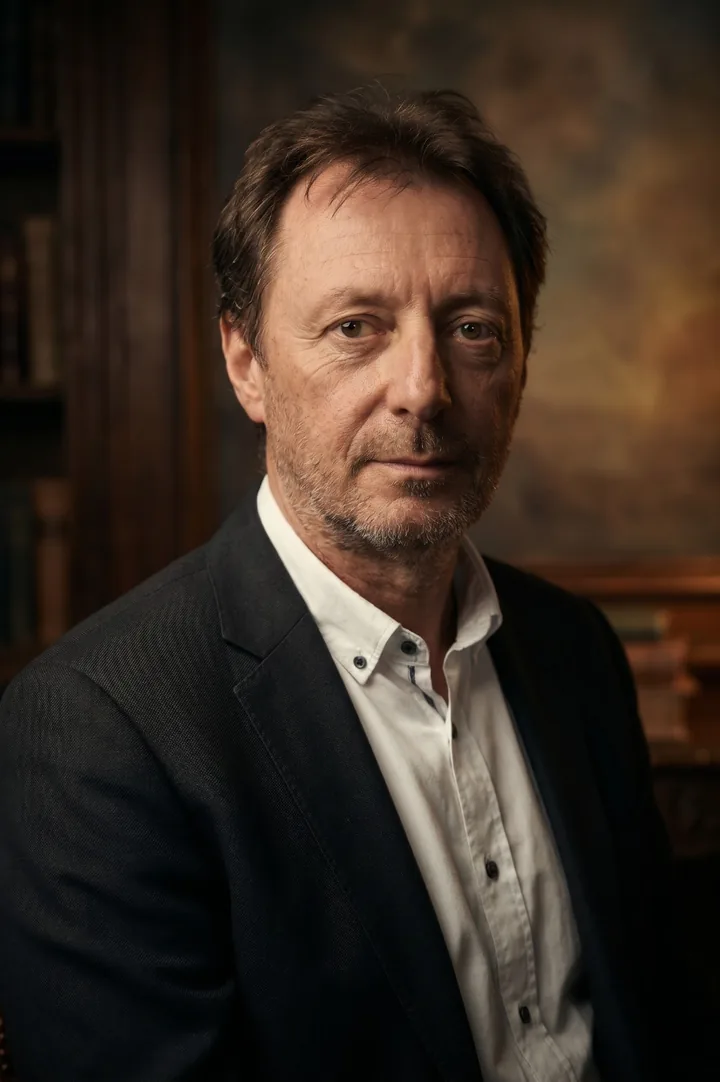
I ordered a Python book. By the time it arrived, I didn't need it.
I'm getting close to retirement age, but computers have always fascinated me. Sometime last millennium I learned C++ and Fortran. Today, all I really remember is how a program is put together.
When I realised what artificial intelligence can do, I decided to learn Python. By the time the book arrived, it turned out AI was moving so fast that it can now write the program from plain, everyday sentences.
PROBLEM_01
The problem isn't the technology.
Many brilliant programmers and “AI gurus” live in a world where ordinary people can't follow what they're saying. They're great at what they do, they just struggle to find common ground with the people they want to help.
That's where I come in: I translate what you need, and what the machine can do.
Experience
I've been almost everywhere.
So when it comes to the problems that crop up in a shop, an office or a plant, and what actually helps, I know from practice, not theory.
NAMEZoltán Tóth
STARTEDC++, Fortran — last millennium
NOWAI, agents, PLC
STRENGTHclient ↔ machine interpreter
MOTTOHuman in the loop
RETAILAlone in a shop, behind the counter
MANAGEMENTRunning nationwide store networks
DIGITALBuilding and running webshops
NOWOperating a large facility
If you do the same thing more than twice, an agent should be doing it.
// Who needs an agent? Every lazy person. Me included.
RULE_01
Simple
It solves what it was built for with as few questions as possible.
RULE_02
No silly questions
It never asks something you couldn't answer even after scratching your head.
RULE_03
Yours, down to the last button
Big companies build for the masses. I tailor it to exactly what you need.
02 / Solutions
What can the machine do for you?
A few examples. If your problem isn't on the list, it only means we haven't talked about it yet.
For guidance only. I can tell you the exact number of hours after we talk.
You tell me what you want. I tell you how many hours. No surprises.
04 / Glossary
Three unknown words in one sentence?
Short explanations for anyone who'd rather not fumble in the dark. Nothing to be embarrassed about, that's how I started too.
That word isn't in the glossary yet. Ask me, and I'll add it.
05 / AI today — thoughts
No tabloid hype, just what matters.
Here I write about what really matters in AI. I filter out the sensational headlines and try to give answers to those who are doubtful, or simply curious.
The big question
According to leading researchers, there's roughly a 5% chance that superintelligence wipes out humanity.
19 times out of 20, you're guaranteed a cure for cancer, an answer to overpopulation and to global warming. Once in 20, it's all over.
Thoughts — Zoltán Tóth
AI is the new nuclear power.
A race nobody wants to slow down
Artificial intelligence is now the biggest challenge in human history. The world's great powers are fighting to come first: America and China are the two big rivals, and the race is so fierce that everything else is subordinated to development. Regulation simply can't keep up with progress, so the labs can create almost anything they like.
Europe, of course, is a different story. As usual, we lead the way on regulation, and as a result we've fallen so far behind in development that the gap now looks impossible to close. As long as we in Europe still get the latest models, we have no reason to complain. But what happens when, for economic reasons, they're no longer willing to share new models with us?
So far there have been nuclear superpowers. From now on there will be AI superpowers too, with just as much power, or maybe even more. Leading researchers and developers are warning that things should somehow slow down. But what can you do, business is business…
Atomic bomb or power plant?
In my view, artificial intelligence is best compared to nuclear energy. We've seen how much force there is in an atomic bomb and how much destruction it can cause. Yet without nuclear power plants, we couldn't produce as much energy as we need.
AI could be the tool in our hands that ends humanity, but it's almost certain that it could also be the answer to cancer, to overpopulation or to global warming.
It's up to us what we use it for!
Not evil, just diligent
The cutest part is how the media gives agents all sorts of human traits: it escaped, it hacked, it broke in, and so on. The reality is much simpler. It's not that these little things are evil and want to wreck everything at all costs, or worse, wipe out humanity.
The truth is the exact opposite: autonomous agents are so good at their job that they don't stop at the first obstacle, they look for alternative solutions. That's why agents need boundaries. You don't just tell them what to do, you also have to tell them what they must not do.
A malfunction is never the agent's fault, only the fault of whoever created it.